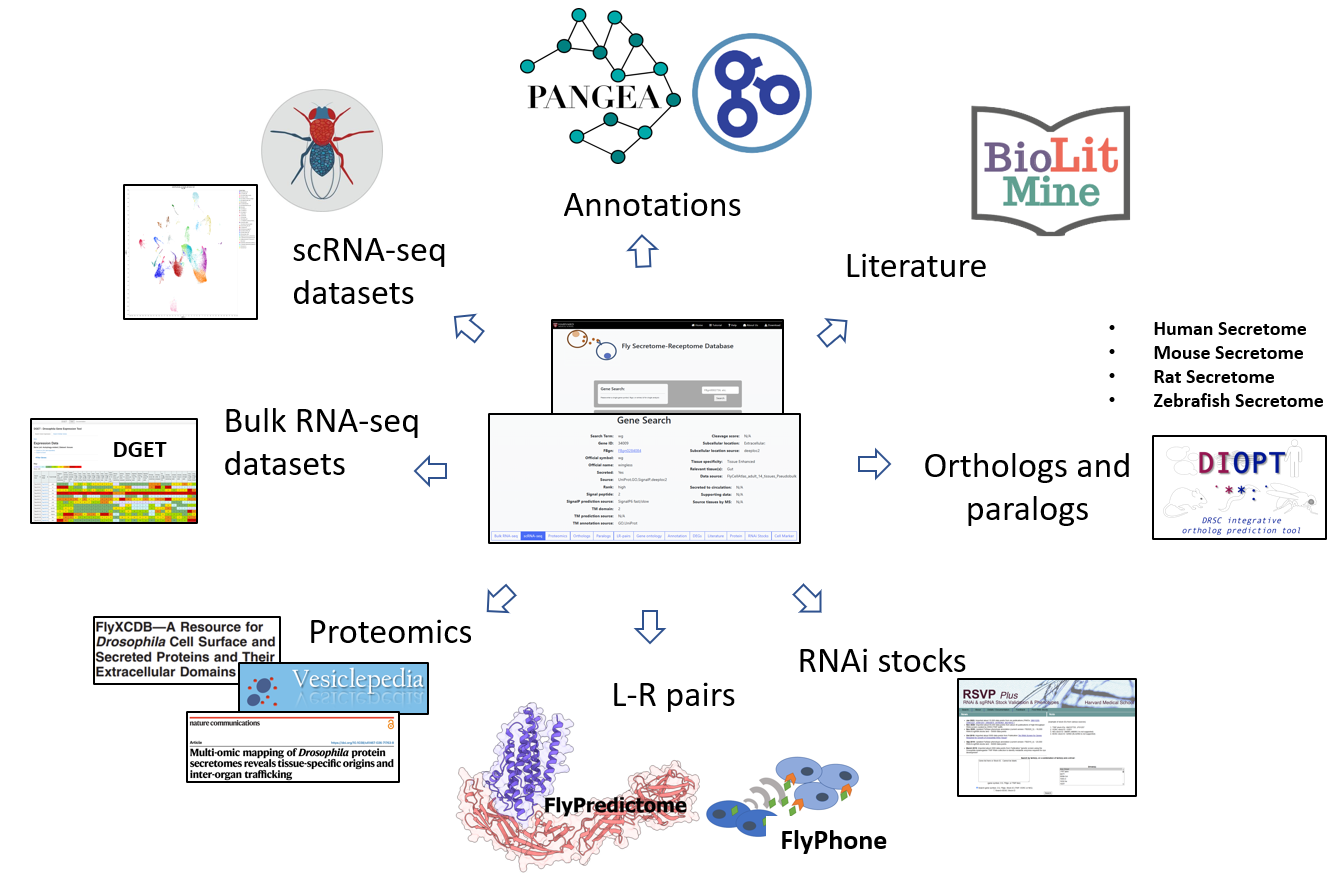
How to use Drosophila secretome?
The Drosophila Secretome online resource provides a dedicated portal for researchers to explore and mine the database. Users can search a single gene to determine whether it is part of the secretome. If so, the portal retrieves and displays the evidence source, confidence tier, signal peptide predictions and subcellular localization predictions. In addition, each entry is cross-referenced against available proteomics datasets, allowing users to determine whether the protein has been detected in the larval circulatory system and, if so, its tissues of origin.
A menu bar with 13 tabs provides structured access to additional information relevant to experimental design. For transcriptomic analysis, a dedicated tab enables mining of bulk RNA-seq datasets, including tissue, cell line, developmental stage, and treatment-focused datasets from the modENCODE and FlyAtlas2 consortia, gut subregion and cell-type transcriptomic profiles, primary cell line transcriptomes, and selected time-course datasets from our lab. Single-cell RNA-seq data are accessible through three separate tabs covering: (1) pseudo-bulk expression values from two full body datasets including FCA dataset; (2) cell-type-specific marker genes; and (3) differential expression across genotypes or treatment conditions, drawn from all published scRNA-seq datasets from our lab. One tab is dedicated to answer where the protein is secreted to eg. circulating system or cell surface based on proteomics data. Additional tabs provide ortholog and paralog predictions from DIOPT, gene set annotations from PANGEA, candidate receptors annotated in FlyPhoneDB or predicted by FlyPredictome, and RNAi stock information to facilitate the identification of transgenic fly lines for functional follow-up.
Beyond single-gene queries, users can perform batch searches by submitting a gene list to identify the secreted subset along with the associated annotations. Users can also browse the complete secretome and apply filters to select candidate secreted genes expressed in one or more tissues of interest, based on FCA transcriptomic data.